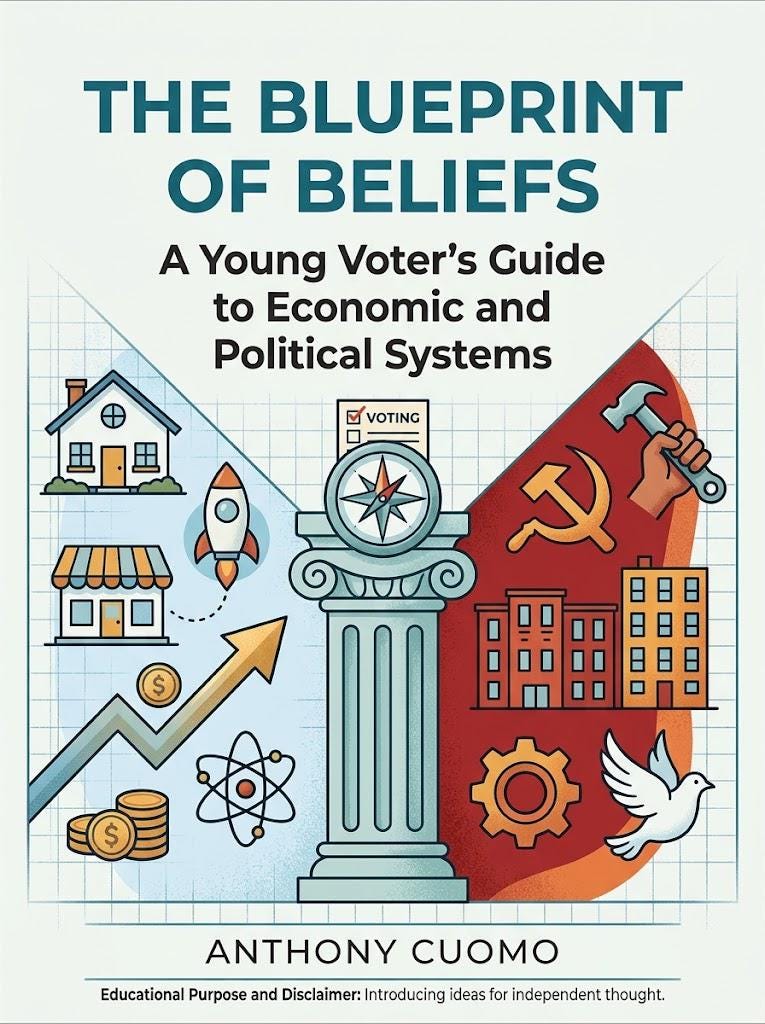
The Blueprint of Beliefs
$14.98
The Blueprint of Beliefs
A Young Voter’s Guide to Economic and Political Systems
Election debates often use terms such as capitalism, socialism, communism, free markets, and the working class. These words describe different ideas about ownership, production, distribution, and government, but speakers also use them as political labels. Understanding the basic definitions makes it easier to evaluate what candidates are actually proposing.
For a first-time voter, modern political debates can feel like a foreign language. Politicians and commentators use economic terms not only to describe how an economy works, but also as political weapons. One side may warn that a policy will lead to authoritarian state control; the other may argue that the current system is unfair to ordinary workers.
When everything is labeled as either "freedom" or "tyranny," it becomes remarkably difficult to find clear, honest answers to simple questions:
• What do these systems actually mean on paper?
• How are they supposed to work?
• What happened when nations actually tried to build them in the real world?
• And most importantly, how do these abstract ideas affect your rent, your job, your taxes, and your future?
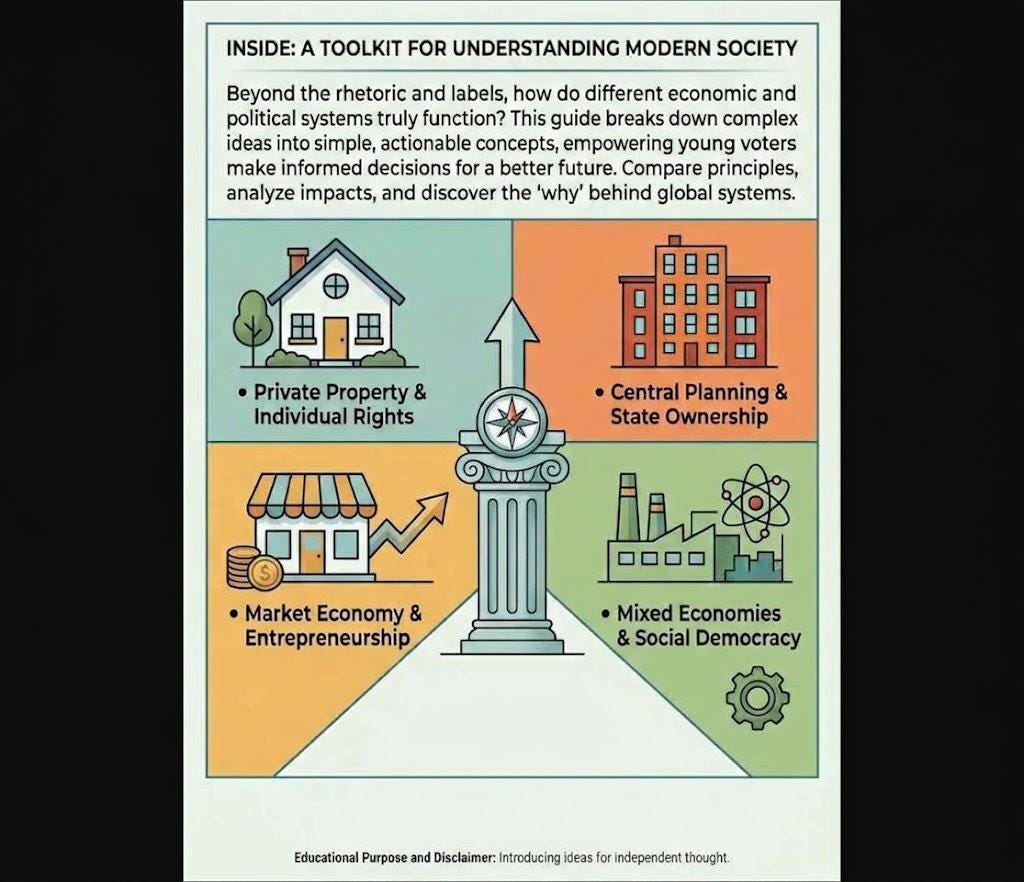
This book is not here to tell you how to vote or push you toward the political left or right. Instead, it is a toolkit designed to look beyond campaign slogans and explain the history, mechanics, and real-world trade-offs of the major economic systems shaping the modern world. It gives special attention to communism and central planning while comparing them with market-based and mixed economies.
By the final page, you should understand the main definitions and have a framework for evaluating political proposals, comparing their promises with evidence, and reaching your own conclusions.
A note on terms and evidence: Political labels are used differently across time and place. In this guide, capitalism refers to private ownership and market allocation; socialism refers broadly to systems with greater social or public ownership; communism refers to the classless society envisioned by Marx and, when discussing history, to governments that ruled in its name. Historical and statistical claims should be checked against reputable primary sources and nonpartisan research.
Digital downloads
Your files will be available to download once payment is confirmed.